
Building the Foundations of a Functioning Biomethane Market
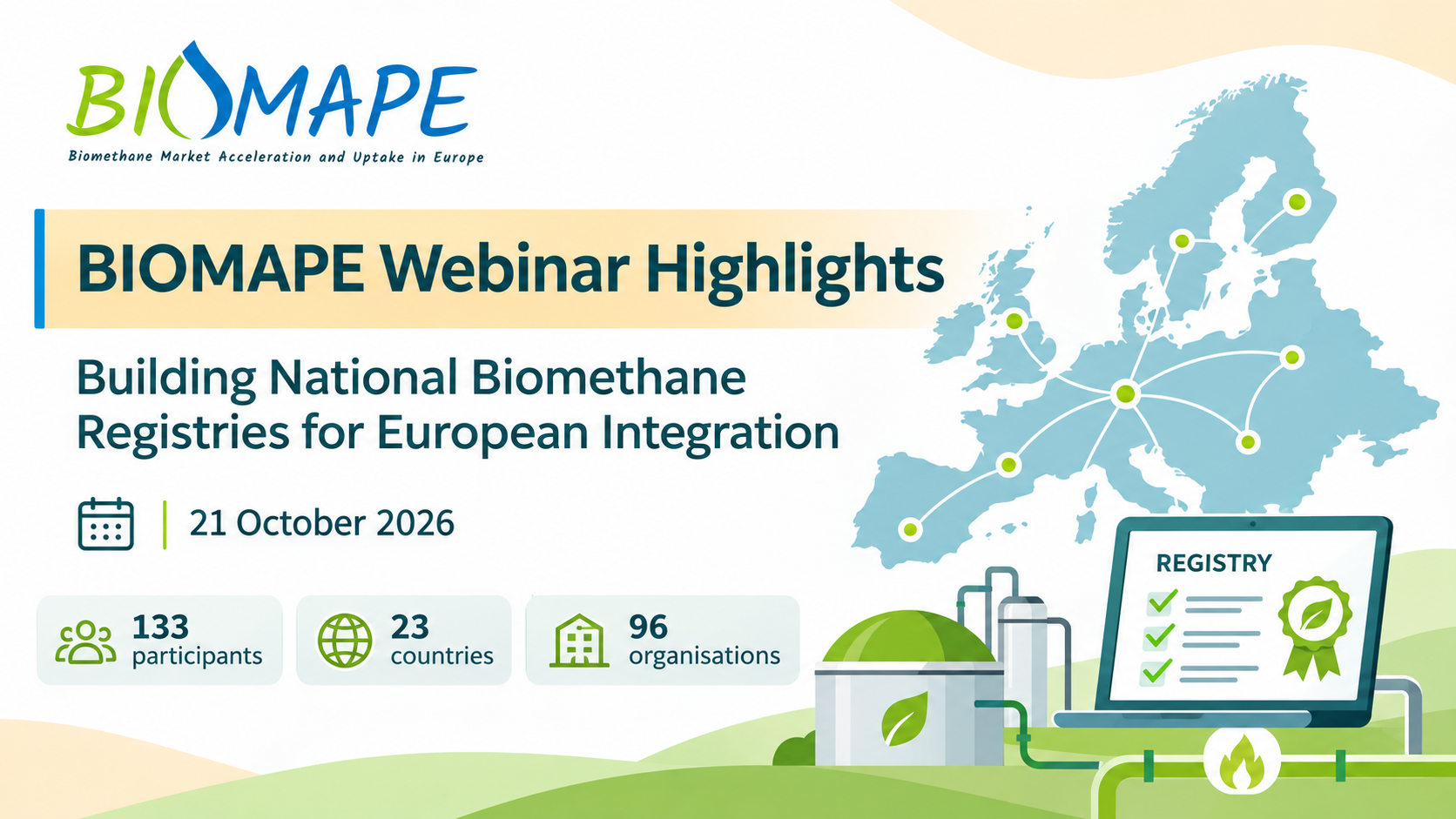
Biomethane is one of the great opportunities of the European energy transition, since the resource is available, the technology is mature and the existing gas infrastructure can be used. What is still missing in many countries is the market infrastructure that turns this potential into a functioning market. Reliable national registries and credible certificates are the tools that make biomethane countable, tradable and bankable. This was the common thread of the BIOMAPE webinar on 21 October 2026, which brought together 133 participants from 23 countries, representing 96 organisations, including public authorities, registry operators, producers, traders and industry associations.
The EU Perspective: Introducing the Biomethane Mechanism
The first session was dedicated to the EU perspective. Mikolaj Jasiak, Team Leader in Unit F.1 Diversification Strategy and Joint Purchasing at the European Commission, DG Energy, presented the Biomethane Mechanism under the EU Energy and Raw Materials Platform, which the Commission launched in June 2026. As a new type of policy instrument, the mechanism is a free and voluntary platform that brings supply and demand together. From 4 November 2026, buyers can submit their demand, specifying volumes, certificate requirements and delivery options, and sellers will be able to respond with matching offers from late January 2027. A regulatory dashboard explains, in one place, the requirements of the eight member states covered so far, Denmark, France, Germany, Italy, the Netherlands, Poland, Spain and Sweden, with Portugal, Austria, Hungary and Romania to follow in the next iteration. In the live poll, more than 90 per cent of participants stated that they intend to register with the mechanism, and the regulatory dashboard was considered its most valuable function.
National Registry Development: Insights from Five BIOMAPE Focus Countries
The second session gave the five BIOMAPE focus countries (Hungary, Portugal, Serbia, Slovenia and Ukraine) the floor, and their presentations drew a differentiated picture of European registry development. Hungary has designated its regulatory authority as registry operator and joined the AIB scheme, but production is still exported to Western Europe in the absence of a national support scheme. Portugal operates a fully functional guarantee of origin registry since 2024 and expects its market to scale from one to around six plants, with 40 projects in licensing. Serbia, which has a solid biogas sector but no biomethane production yet, sees a greenfield advantage, as the registry can be designed from the start, following the phased pathway that BIOMAPE recommends, from a production data core towards a fully integrated system. Slovenia is preparing both a renewable gas registry, with establishment starting on 1 January 2027, and a dedicated support scheme, two prerequisites for a market that has not yet started. Ukraine combines an estimated production potential of up to 21.8 bcm per year with an operating registry in trial mode, and is evolving towards a system that separates guarantees of origin from proofs of sustainability, in preparation for connection to European systems.
BIOMAPE Deliverable D2.1: Guidelines for National Biomethane Registries
The third session presented the results of the BIOMAPE Deliverable D2.1, the updated guidelines for establishing national biomethane registries for certificate management, which are available on the BIOMAPE website. The report defines the common attribute layers of renewable gas certificates, describes the business processes and roles of a registry, and introduces a typology of seven registry system types. Its country mapping covers, in total, 18 European countries, among them the BIOMAPE Lead countries (Austria, Ireland and the United Kingdom), the Focus countries (Hungary, Portugal, Serbia, Slovenia and Ukraine) and further European reference markets. Four of these types reflect the historically grown landscape of issuing bodies, biofuel registries, hybrid and parallel systems. The production database, the data centre and the fully integrated registry system are the three forward-looking proposals of BIOMAPE. Together these form a blueprint for two situations. Countries that already operate parallel systems can streamline their data flows without replacing their registries, and countries that are building their structures now are advised to aim at a fully integrated system from the start. The subsequent guided discussion addressed social acceptance, which showed the full breadth of the focus country experience, from local protests against biogas installations to strong governmental support through a national bioenergy coordination council.
Looking Ahead: Towards an Integrated European Biomethane Market
The event closed with a clear outlook. The untapped potential of biomethane is held back above all by the missing digital market infrastructure and by hindrances in cross-border transfer. Interoperability between registry systems, within the European Union and with connected countries, is therefore the central task ahead, and the EU Biomethane Mechanism was recognised as a clear signal that the European Commission regards biomethane as an integral part of Europe’s energy security. The next milestone of the work package will be a handbook for economic operators on the European cross-border trade of biomethane certificates, expected around mid-2027. Countries and stakeholders interested in BIOMAPE’s support are invited to get in touch via the project website.
Explore the webinar materials
Missed the webinar or want to revisit the discussions?
Our project partner, the European Renewable Gas Registry (ERGaR), has made the webinar resources available online, including:
The webinar forms part of BIOMAPE’s efforts to support the development of national biomethane registries and facilitate certificate management and cross-border trade, contributing to a more transparent and integrated European biomethane market.

