
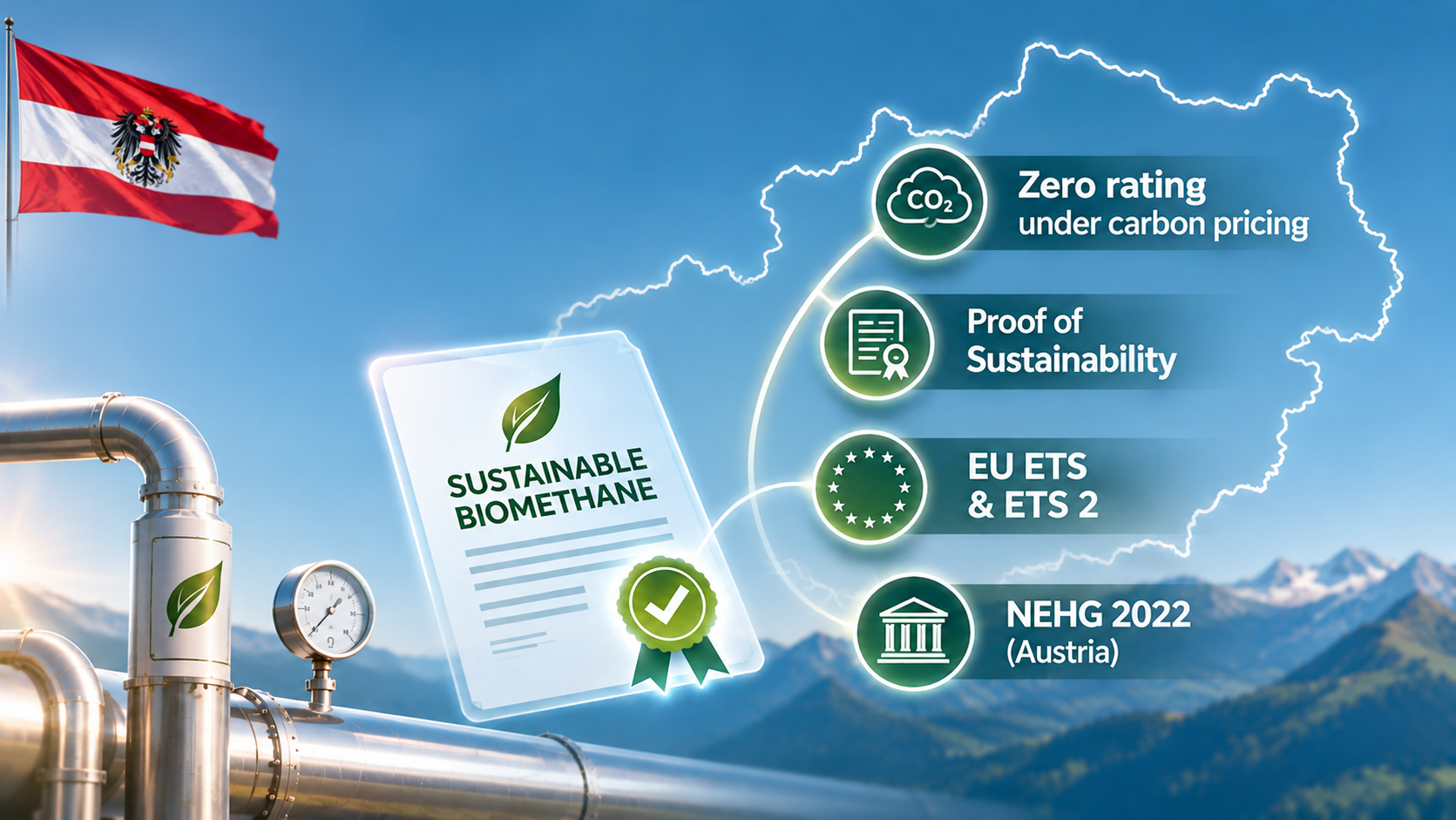
The Federal Ministry of Finance has confirmed that biomethane with a proof of sustainability under the Renewable Energy Directive is rated at zero under Austrian carbon pricing and remains outside the scope of the forthcoming ETS 2, which turns sustainability documentation into a direct fiscal asset for producers, suppliers and customers.
Carbon Pricing and the Role of Sustainability Documentation
For biomethane, the economic effect of carbon pricing is decided by the question, whether the carbon contained in the gas is rated at zero. Where the rating succeeds, the fuel is spared the cost of emission certificates and its competitive position against natural gas improves with every rise of the carbon price. In the European Union this question is answered through sustainability documentation, because the zero rating is available only for biomass that complies with the sustainability and greenhouse gas saving criteria of the Renewable Energy Directive.
Recognition of Sustainable Biomethane under the EU ETS
Under the established EU ETS for stationary installations and energy generation, operators may assign an emission factor of zero to biomass fuels, including biomethane, only where the fuel complies with these criteria and a Proof of Sustainability issued under a voluntary scheme recognised by the European Commission is available. The Monitoring and Reporting Regulation 2018/2066, most recently amended in September 2024, aligns the monitoring obligations of the EU ETS with the Renewable Energy Directive and extends the documentation requirements to the regulated entities of the future ETS 2. In Austria, recognition under the EU ETS is possible only through the purchase of sustainable biomethane, and where biomethane is balanced via the public gas network, double counting must be excluded.
ETS 2: Zero Rating and Regulatory Requirements
The second relevant system is the ETS 2, created with Directive (EU) 2023/959 as a separate European emissions trading system for fuels used in buildings, road transport and additional sectors. The obligation rests upstream with the fuel suppliers, who pass the cost on in their prices. Monitoring and reporting obligations have applied since 2025. The market phase, originally foreseen for 2027, was postponed by one year to 2028 following the agreement of the European co-legislators of November 2025, which was formalised through Regulation (EU) 2026/667, in force since April 2026. For biomethane, the Federal Ministry of Finance has now confirmed the decisive principle. Where a Proof of Sustainability under the Renewable Energy Directive is available for the biomethane quantities used and the requirements of the Monitoring and Reporting Regulation are met, no emission certificates must be acquired for these gas quantities. Biomethane therefore remains outside the scope of the ETS 2, and the Federal Ministry of Finance has confirmed the same for the Austrian national system that will be transferred into it.
Austria’s National Emission Certificate Scheme (NEHG 2022)
That national system (NEHG 2022) has priced the carbon content of fuels for buildings and road transport since 2022 and remains in force until the market phase of the ETS 2 begins, at a fixed price of EUR 55 per tonne of CO2 in 2026. In practice, the zero rating under the NEHG was previously tied to the linkage with the Austrian natural gas levy act, which made the fiscal recognition of biomethane difficult. This linkage is no longer a mandatory precondition. The applicable requirements are now those of the Monitoring and Reporting Regulation 2018/2066, on which both the ETS 2 and the current version of the NEHG rely. An amendment of the implementing regulation, published on 30 December 2025, specifies the evidence required for the zero rating of carbon shares, and the Federal Ministry of Finance explicitly requires a Proof of Sustainability conforming with the Renewable Energy Directive. Because the trading participants have had to align their monitoring plans with the Monitoring and Reporting Regulation since 1 June 2024, the emission reports for the 2025 reporting year must follow that regulation, and the zero rating therefore already applies to the 2025 reporting year.
Proof of Sustainability: Certification and Traceability Requirements
The zero rating is subject to strict conditions that concern the entire supply chain. Any double use of a Proof of Sustainability must be excluded, the documentation along the chain from the feedstock to the delivered gas must be complete and consistent, and producers as well as traders of blended biomethane must be registered and certified under a voluntary scheme recognised by the European Commission, because only certified economic operators may issue and pass on Proofs of Sustainability. The Proof of Sustainability thereby becomes the central document of the Austrian biomethane market, since it is the key that unlocks the fiscal advantage in all three systems.
Market Opportunities for Producers, Suppliers and Customers
For the market participants, the confirmed legal situation opens concrete business opportunities. Gas suppliers and energy traders can develop biomethane products in which the cost factor of carbon pricing is reduced or fully avoided, and industry and heat customers receive a clear incentive to switch to biomethane, because they avoid the additional burden that the ETS 2 or the NEHG would otherwise place on fossil gas. For the Austrian biomethane producers, it is worthwhile to extend their offers along the value chain, because the benefit of the zero rating grows with every reliably certified biomethane flow.
Sources and Further Reading
- Kompost- und Biogasverband Österreich (4 March 2026) – Nullbewertung von Biomethan im Rahmen der CO2-Bepreisung endlich möglich
- Kompost- und Biogasverband Österreich (4 February 2025) – Erster Herkunftsnachweis mit Nachhaltigkeitsinformationen generiert
- EUWID Recycling und Entsorgung – Österreich: Nullbewertung von Biomethan bei CO2-Bepreisung möglich
- European Commission – Guidance Document No. 3: Biomass issues in the EU ETS
- Environmental Protection Agency Ireland (February 2025) – RED II Biomass Requirements for EU ETS Participants
- European Commission – ETS2: buildings, road transport and additional sectors
- European Environment Agency – EU new Emissions Trading System (ETS2) and Social Climate Fund
- International Carbon Action Partnership – EU Emissions Trading System for buildings and road transport (EU ETS 2)

